Thinking Vegetarian in Mongolia? Think Again! A Vegetarian Survival Guide to Mongolia by Matthew Lynch

Vegetarians beware.


There may be plenty of vegetarian dining options in Ulaanbaatar, the capitol city of Mongolia, but if you are planning a trip to Outer Mongolia, make it a short one. Or bring lots and lots of your own food supplies.

Let me take you to Tosontsengel, in Northwestern Outer Mongolia, where we are treated to an old-style Mongolian Barbeque …’A Feast For Kings’:
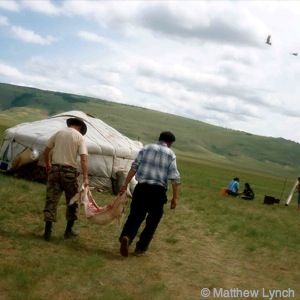

The sheep is slaughtered using the traditional technique – I’ll spare you the gory details here, but just imagine that scene from Indiana Jones and the Temple of Doom, and you’ll get the picture.

First course is a rich mutton broth made from the water in which the internal organs have been boiling away for the last three hours.

Second course, you guessed it, the organs are presented to the guests of honour first – slopped into a steel bowl and placed at your feet with the handle of a large, sharp knife that has been made for meat-eating pointed in your direction. Dive in and carve off a piece of lung, kidney, or heart for your dining pleasure.


The organs are the most nutritious, and therefore the most highly prized part of the animal. Mongolia freezes over during their long, harsh winters, and the nomadic herding lifestyle has evolved in response to act as a family’s energy store through the cold months; hence Mongolians’ love of meat, meat, and more meat…

…Third course? Another version of mutton broth, to cleanse your palette – this one richer than the first, if that is possible, made from the water the rest of the carcass has been simmering in for the last three hours…

Don’t forget the condiments! Pickled green tomatoes, potent wild onions, zesty pickled beetroot, and perhaps some baby boiled potatoes. Mongolia’s growing season is short, and conditions harsh [try growing vegetables in the Gobi Desert!], so if you are lucky enough to be served veggies in the countryside than know that you are truly being treated as royalty.


Fourth course is slightly more recognisable cuts of meat served up in another bowl, with more knife handles pointed at your belly so that you can hack a chunk of meat from the bone you’ve picked. Wipe the grease from your hands on the leather bridle which is passed around the yurt; clean your hands and keep your hosts’ riding equipment soft and supple at the same time.

Take another sip of the traditional, ubiquitous salty milk tea called ‘tsu-te-tse’; milk is another highly nutritious product of the nomads’ animal herds, and is preserved by making it into cheeses and yoghurts. Diluting milk in tea is another way to stretch this precious resource further. Then, brace yourself for the next course.


The fifth course you will not have seen before: the boiled sheep’s stomach, bulging with its mystery contents, is presented on a platter. Your host produces his knife with a flourish, and deftly opens the sac to reveal… the sheep’s head, whose lips have been drawn back into a macabre smile when its hair was singed off in preparation for your meal.

A couple more slices of his knife, and the tripe bag opens to reveal the sheep’s shins and hooves, which have also been singed, and stuffed in along with the ‘happy’ head, whose jaw now drops open with a dull ‘thud’, turning its grin into a toothy guffaw.

But wait, there’s more! …the fatty tail pad has been scooped out, filled with minced meat, sewn shut and boiled next to the stuffed stomach for the last three hours – it is this part that was considered to be Ghengis’ favorite meal – A Feast Fit For The Khan.


Vegetarian Survival Guide to Mongolia:

  1. Cling to the first piece of meat offered to you and nurse it through your entire meal. If you pick this bone clean your hosts will only offer you more.

2. Hold your breath when sipping the organ stew. Have some bottled water or fruit juice nearby in your canteen to wash the taste out of your mouth.

3. Beam with delight when offered pickled vegges or [on the very rare occasion] green salad to encourage your host to offer you more.

4. Sit next to a friendly carnivore whom you can offload your meat dishes upon when nobody is looking.

5. Clap your hands like a madwoman when the yoghurt appears. If you do this well, it will be lovingly prepared with clotted cream and sugar as you swallow back your drool. Your belly will thank you for this.

Dewalokam- India’s Green Nirvana

Dewalokam Farmstay Retreat will attend to the needs of guests with such precision, detail, and desire that you will feel as if you are the only individual staying here. The warm service and smiles offered by the well-spoken and understanding locally employed staff offers you a taste of India’s excellent customer service minded nature. Their knowledge of Dewalokam’s grounds and India’s natural resources surrounding the lodge reflects the time and effort spend in the training procedures to ensure customer service excellence. Furthermore, it shows the dedication behind green travel and Dewalokam’s insistence behind establishing a place that will provide sustainability and minimize the destruction of precious natural resources.

In order to remain a fully functioning, comfortable, and sustainable eco retreat, Dewalokam hosts its own collection of animals, and farm gardens to supply the guests and staff with a broad selection of local and organic food. This carefully selected, grown, and tended produce is transformed into mouth-watering meals tailored to perfection and giving the guests a generous serving of Indian delicacies. The farm produces its own vegetables, fruits, dairy, honey, meat, and fish to ensure hygienic and healthy food items to choose from. The guests may even chose to discover the farm work for themselves by exploring the fields and helping out the local farmers in sampling their own evening dinner. One may even be guided on a spice walk, be taught about the various spices that Dewalokam grows for its ayurvedic herbal treatments. Follow this up by a relaxing ayurveda treatment or a yoga class.

If you prefer a more adventurous form of activity, Dewalokam offers total emergence into India’s natural wonders. Discover the mystical jungles by organizing a day of forest trekking and discover the soothing sounds of exotic birds, or be amazed by the thousands of fruitbats that call the forest home. Or discover the thundering waterfalls hidden amongst the luscious greenery. Perhaps a guided tour on a bamboo raft, while enveloped by nature and allowing your eyes to feast on the many birds and junglelife, satisfies the senses.

If you wish to relax and retreat, you may do so in one of the hammocks located around the grounds, as you sway along with the steady breeze and listen to the only sounds that breaks the natural silence; the songs of birds.

The rooms function on alternative forms of energy, water is conserved, and all natural resources are managed to minimize waste. If you happen to be too full after the taste bud tingling meals, any scraps will be offered to the compost facilities. Your comforts will not be sacrificed while saving the environment. Comfortable and hygienic rooms and privacy alongside the beautiful swimming pool is what you may expect from this pristine natural haven.

Recycling Buenos Aires

BUENOS AIRES–As a means of exploring one of South America’s biggest cities, I ran.

I passed zipping cars disobeying traffic laws, father and son duos juggling hacky sacks for cash, and parillas–Argentine barbeques–spilling their sweet smoke into the streets.

Eventually I found myself on the outskirts of the city drawn to a warehouse surrounded by a chain link fence with a grassy dirt road leading up to its entrance. There was a pile of junk out front made up of car parts, plumbing pipes, machine motors and random metal scraps.

Tending to the pile were young men and women, sifting through it, organizing it into like parts. “Is this a recycling plant?” I questioned, and then there was the triple double-take. Beyond the amounting pile of parts, there was a billboard tower with gigantic ants crawling up it. They were made from ingredients of the “junk” soufflé just to my left.

Argentina’s recent history is characterized by political turmoil, economic crisis, and skyrocketing unemployment. While Argentina has been focusing on recovery, developed countries have been spending most of their effort attacking global climate change and incorporating sustainability into their political strategy.

Sustainability is based on the concept of using the earth’s natural resources in a manner that sustains the world’s current lifestyle while not depleting our natural resources for use by future generations. A sustainable practice is usually comprised of three main aspects: profitability, social and economic utility, and environmental soundness.

In the United States, the “green movement” has become the face of this effort, an overall positive effort but one that is, unfortunately, undercut with green washing (things that aren’t actually green), and overly expensive products. Although Argentina voluntarily agreed to the Kyoto protocol, an international environmental treaty aimed at reducing green house gas emissions, the emissions believed to be the leading cause of global climate change, not much has been achieved on the Argentine environmental front. Very few experts look to South America for inspiration and leadership in the green movement. With this in mind, I began to examine the warehouse.

As I turned away from the ants, a squat scraggly man who looked like he had swallowed a yoga ball, cigarette in hand, red wine in the other, 2 p.m. on a work day, said “hola.” I asked if I could come inside. He told me there was a five-peso entrance fee. “I’m running,” I said. “I don’t have anything on me.”

“Dame sus zapatos” (give me your shoes) he said, laughing ruggedly and opened the door at the same time, welcoming me in. I looked down at my $100 kicks and chuckled. This man was the artist, Carlos Regazzoni, and landlord. He had squatted the abandoned warehouse and adjacent land 10 years prior, and convinced the city, through his art, to donate the space to him.

Inside there were a few more young people cleaning up the old wooden floor of the warehouse and working on their own art. I was the only visitor. There was a brick oven at the South end of the building, except instead of bricks and a ceramic dome, the structure was made from metal scraps and what appeared to me to be the top half dome of an air vessel. There were chairs and tables and they were all different shapes, sizes, and colors.

One of the chair legs was even made with the bottom of a golf club. The sliding doors in the back were wide open, allowing natural light – not coal or oil based electric light- to fill the area. There were paintings from various artists hung on the wall with wire dangling from old copper pipes. I asked to use the bathroom and found that the toilet paper holder was a an old plumbing pipe that held the wads of softness perfectly in spinning position and had a metal cap that could be screwed on and off to change the roll. Every last detail was an item that was re-used, and every last detail was perfectly functional in its role.

“This is a pretty large space. It must take a lot to heat it,” I questioned.

“We throw on double sweatshirts and drink hot cocoa with whiskey. Pretty easy actually,” Regazzoni said.

As groups of visitors filtered in, I decided to stick around for dinner, which I had agreed to pay for at a later time since I didn’t want to give up my shoes and planned on returning. The young men and women who had been scattered around throughout the day working on their own art or cleaning up the space, were now preparing food in the half-dome-air-vessel oven, and waiting on the visitors. They were earning their keep in return for the opportunity to be part of the art community and have access to materials, space, and inspiration.

Dinner was some of the best milanesa–an Argentine dish where meat is pounded into a thin slab and breaded with seasoning–I have tasted. Peering into the kitchen, I saw that they were taking food scraps and putting them into a composter. They used the compost to fertilize a garden in the back that they in turn harvest for the meals they cook. To top it off, when the workers waited on us, they acted, playing different characters in preparation for a play they were to put on the following week.

Regazzoni’s recycled sculpture art is innately a form of recycling at the least. But more so, the entire concept of taking someone’s waste and turning it into beauty, inspiration, and furniture, all part of a self-returning learning environment, cuts deep into the true idea of sustainability. An example that is not limited to only those who can afford it, but with resourcefulness and creativity is accessible to everyone.

Regazzoni’s warehouse would certainly not get a United States Green Building Council LEED certification. But in comparison, the carbon footprint of turning the existing space into a community center, self-supplied restaurant, theater, gallery, and garden using all un-processed recycled materials was a multitude less than the carbon footprint of building the Getty Museum in L.A., a LEED silver rated building. Though the Getty is an incredible museum, Regazzonis’ warehouse is ranked right up there with it in my book.

Sustainability was unassumingly and genuinely captured in Regazzoni’s space and in a developing country. There, it was unforced and free of smoky mirrors; something we in the U.S should consider in the face of a popular, sophisticated, positive, but sometimes misleading “green movement.”

I’m Dreaming of a Green Christmas…

The holiday season is upon us and it would only seem fit to discuss the impact some of our Christmas traditions have on our environment. Most of us will be travelling during this time; whether a long deserved beach holiday in the tropics, or an adventurous road trip to visit the family and spend Christmas with them. So, how do you go about travelling such distances without wreaking havoc on the environment? It is fair to say that planning a trip to Fiji, for example, would involve air travel; unless you were to set aside several months to get there the green way. It is hard to avoid airplanes if you plan a long distance trip, so putting that aside, how can you be green at your holiday destination?

1. First off, check-in at an eco-friendly hotel. In the rising eco-tourism economy plenty of reliable, safe, and fantastic places have sprouted in the region. Surely, there should be something to satisfy your senses; luxurious, simple, cozy, kid-friendly; you name it. And when you find something; don’t be afraid to spread the word and let us know!

2. Take the public transport in your country of destination. Not only will it save you plenty of money, you’ll be surprised what you can find when you emerge yourself in the local way of life. You often arrive at destinations which are much less touristy, and undiscovered by the commercialized sectors of the city.

3. Choose green activities. Hire windsurfing equipment over a jet-ski; not only will it be much less disturbing to the underwater world, you won’t be polluting the oceans with toxic engine wastes. Go for a bicycle ride or hike through the lush landscape instead of staring out the window of a taxi.

4. Seek out the eco-friendly tours, there are plenty around and if you consider the pollution levels from a full daytrip; it may encourage you to put in that little effort and tour the green way. You can find information at local tourist offices around the place you stay and often your eco-hotel will offer their own trips and activities designed to leave nothing but a memory of your own to be remembered.

If you can start by introducing just these few tips in your travel plans, it will make a big difference.

Of course not all of us are planning on an airplane trip; some will visit family and drive down to spend Christmas with them. Well, how about taking a bus? You will not have to drive, pay for gasoline, and cost the environment. Even with the kids you will not run the risk of being distracted when they quarrel in the backseat. Plus, for your own safety; we all know the holiday season still brings about plenty of raod hazards, whether the weather conditions or the many irresponsible drivers out there. I know I’d feel much safer in that big, tough bus. Do the right thing, do the green thing.

I say Eco, you say Eco, we all say What?

Ecotourism. Ecolodge. Ecotravel. Sustainable tourism. You see these words inscribed on almost every hotel, every tourist destination, and on the tip of every travel promoter’s tongue. Do we really know what we are talking about when we mention any of these terms? Our society has become so eco-orientated, desperate to come across as environmentally friendly, that soon we will be drinking eco-friendly water from a plastic bottle. Seriously? Assumedly we have all been travelling eco-friendly because we did not wash our towels every day, but the truth is, that is not what ecotourism is about. Quite frankly, there is no ‘one’ definition, there is no ‘one’ way of spelling the terms either. It has become an overstated description to satisfy our guilty conscious because deep down inside, that eco-trip last summer; you guessed it, it wasn’t so eco-friendly at all! Let’s start by, ‘How did you get there?’ Unless you walked, or swam it really was not so eco at all.

I am not even going to mention the possible un-eco side problems that come with swimming or walking, however I am not here to criticize anybody because I am just as guilty. Instead I intend on praising everybody for trying to at least make a difference, to spread an environmental statement across, and to ensure that even if they do travel they do so with as little impact as possible. That is the keyword here; possible. We have to do with what resources are available to us, and this techno-society of ours has given us a lot of opportunities to make a difference; to minimize our impact.

However, I stumbled across an article by the BBC by a man named Dr. James Mair and he points out that eco-tourism is doing more damage to the environment than good. I find his opinion hard to grasp, not only because he writes in ways I do not fully comprehend but also because I think he mixes up REAL ecotourism with the supposed ecotourism. I think he targets eco-hotels that only say they are eco-friendly to attract the growing numbers of eco-tourists but which are quite confused about what ecological preservation in the tourism industry really means. I am sure we have all come across these forms of accommodation and it is certainly difficult to distinguish the real from the ‘wannabe’. Furthermore, a lot of the waste that is washing up or causing destruction tends to be the lingering results of non-eco hotels. That is probably where it goes wrong, having both non-eco and eco-friendly accommodation on one island. I say, “Let there be green”.

Of course, I am not dr. at the Centre for Marine Biodiversity and Biotechnology at Heriot-Watt University in Edinburgh and my opinion is probably way off, but I cannot see how a resort or hotel which have been assessed by green criteria or recognized by a known and accepted green organization could be doing any harm. Not in their vicinity at least. Possibly because they encourage more travelling to eco-friendlyeco-resort destinations and the travelling process itself is damaging, but in all honesty in this world people are going to travel. Is it not better that we travel eco-consciously (the airplane is bad, but those 5 days in that will wash away those sins) rather than travel and damage the whole lot? Like a vegetarian, we may think that one steak does not make a difference but if 1,000 vegetarians pass on it, it may save a cow or two (probably many more).

New Marine Park “Sinks” My Boat

A one million hectare marine park. Isn’t it fantastic that our world is finally realizing the terrible impact global warming and ecological destruction poses on our society? Northern Sabah has been planning this for seven years. The park has shown a greater range of biodiversity than the Caribbean and Great Barrier reef in Australia. It is called Tun Mustapha and fantastic initiative by Malaysia and various environmental protection organizations to preserve the world’s natural wonders.

According to Science, Technology and Innovation Minister Datuk Dr Maximus Ongkili it is just in time, “Any further delay will lead to the sensitive areas being further degraded.” Borneo is a popular eco-tourism destination, offering an exotic and wide range of flora and fauna however is threatened by the dependence on the fishing industry. The areas to fall into this marine park are Kudat, Kota, Maruda, and Pitas as well as 50 islands in total.

This area will be the largest conservation region in Malaysia, incorporating a population of 80,000 who are sustained by the fishery industry. Nevertheless, researchers from Maruda Bay and Universiti Putra Malaysia have found that opening this conservation park will give way to many new job opportunities. Based on their findings the population will have the options of developing and working in green tourism, homestays, aquaculture, sea cucumber and cage fish rearing, oyster breeding, sea transportation, mangrove boardwalks and bird observatories. Considering the eco-tourism industry grows with 5% annually worldwide, this form of economic income will likely keep expanding not costing the environment and its wonderful life nor the people in the conservation regions.

Aside from helping the environment, and giving more travel options for the ecological traveller, it will also offer the people in the region to explore more than just primary resource gathering and form independent forms of business in an eco-friendly manner. So far, all I see is a win win situation all around! Or am I missing something?

The Chain of Eco tourism: Tying Environmental Awareness to our Society.

All across the globe Eco-hotels, lodges, resorts, and other forms of accommodation have sprung up. Promoting their environmentally friendly approach to all forms of travel; luxury, cosy, and backpacking. Recently, hotel and resort chains have begun taking on the challenge of reinventing themselves as Green sustainers. One such chain is the well known Club Mediterranée, they have signed another ten year partnership with Green Globe certification to further introduce their bid for establishing sustainable accommodation.

Club Med is located in 40 different countries, with 80 resorts across 5 continents. This widespread distribution in itself, coupled with an environmentally approach can be an influential factor in the tourism industry. Hopefully encouraging more forms of accommodation to take on this approach. If Club Med fully converts all their villages to a recognized level of sustainability in accordance with the Green Globe Certification process, it would make a definite impact on sustaining the environment.

According to Club Med’s Director of Sustainable Development, Agnes Weil, 11% of their accommodation villages is already eco-certified. “Club Med has worked with three major international organisations in the sustainable tourism field, and appreciates Green Globe Certification’s reliability and dynamism.”

Green Globe is a system based on an internationally recognized sustainability system using accepted criteria to rate operation and management of travel and tourism. At this moment, four Club Med villages are Green Globe certified: Club Med Turkoise (Turks and Caicos), Club Med Chamonix Mont Blanc (France), Club Med Punta Cana (Dominican Republic), and Club Med Cherating (Malaysia).

This Green Globe programme installed at Club Med, has already proven to be efficient and produced results when compared to the villages not yet introduced to this Eco-approach. The Green Globe CEO, Guido Bauer, has noted that, “…that those Club Med properties who have already completed the certification are currently saving from 4-6% more water and 2-8% more energy compared to villages that are not yet fully involved in our program.”

Let’s hope that one day we can see the effects of these changes on our environment and that more hotels will follow suit!

Golf while helping the environment


Dear readers


Golf have too often a very negative impact on environment, generally on water, fauna and flora. We have seen disastrous golf developemnt on the planet …

Thats why we are happy to introduce an original concept: Tee for Tree

Well Planet introduced a unique and noble golf tee brand; Plantee. The integrated concept “teefortree” is exactly the reason why this tees is much different then all other existing golf tee brands. The concept is simple: for each tee sold a tree will be planted in an area where agroforestry is badly needed. So the more tees sold, the more trees will be planted!

In this way Plantee helps people in South America, Africa and Asia improve livelihoods and restore degraded land. Good for them, planet earth and generations to come. For the full and more detailed explanation I refer to the website: www.teefortree.com . Check it out!

Marriott’s IT department awarded for its Green behaviour

Marriott was in fact the sole hotel group to be part of the 2010’s ‘Top 12 Green IT Companies’, awarded by Computerworld magazine.
Marriott was recognised for its efforts to make its hightech operations more energy effi cient and less wasteful. As an example a new cooling system for the company’s data centre and improved temperature management, which allowed a 5-7° temperature increase and a water consumption
reduction of approximately 58% since 2007.
Other actions include server virtualisation, desktop power management and recycling of IT assets.
More info at www.computerworld.com

Maldives – leading by example: Climate-conscious Maldives Prez adopts solar energy

It might be a very symbolic gesture but it is clearly a great communcation success: so as to to persuade world leaders to go green and demonstrate their commitment to renewable energy, the President of the Maldives, Mohammad Nasheed will adopt a solar energy model at his residence shunning non-renewable energy.

The Maldives are widely known as a luxury travel destination where luxury hotels are developing fast all around these islands that are on average 5 feet under sea level.

Here his video , at the UN Climate Summit Copenhagen advocating action against Climate Change

Nasheed, last year, had led his cabinet into an under-water meeting t highlight the dangers of global warming and the risk the rise in water levels posed to low-lying islands like his country.

More details on ecotourism at https://www.greenty.com/